
Mindfulness
Integrating Mindfulness Activities
The second step in the SMART wellness framework is Mindfulness. Having a daily routine of structure should include both academics and mindfulness-based self-care strategies. There are many different mindfulness-based activities and strategies that you can incorporate into your daily routine that will help you achieve a healthy academic/life balance.
Identifying the mindfulness-based strategies that resonate with you the most is important because you want to make sure you enjoy them and are more likely to keep practicing them.
As you saw in the first step, Structure, part of your morning routine can include listening to a brief guided meditation or practicing breathwork. Part of your evening routine can also include listening to a brief meditation, reading a couple of pages in a book, or reflective journaling for self-awareness. However, there are other strategies available to you as well. Below are a variety of mindfulness-based strategies that can easily be incorporated into your daily routine.
Mindfulness for Medical Students
A study of highly effective medical students by Bin Abdulrahman et al. (2021) was managing disruptions such as social media use. Their study also found that spending some study time alone increases knowledge retention.
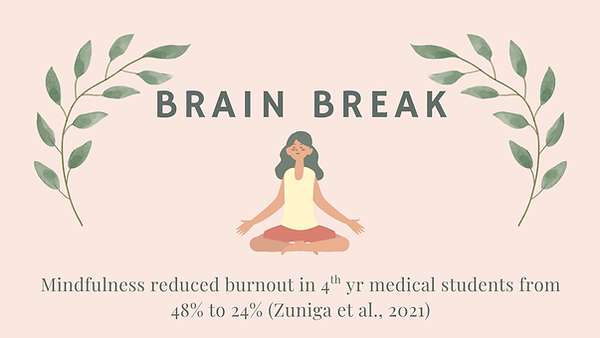
Other studies on mindfulness with medical students have shown positive results such as increases in focus and resiliency and decreases in stress and depression.
Mindfulness and Mindfulness-Based Activities
Mindfulness, defined simply, means being in the present moment - acknowledging thoughts and feelings whether they are good or bad.
Mindfulness also means coming back to the present moment with the use of grounding techniques such as breath work.
Practicing mindfulness can also help you become more self-aware and self-kind, step four of the SMART approach.

mindfulness-based
stress reduction
Mindfulness-Based Stress Reduction (MBSR) was developed by Jon Kabat-Zinn in 1979. With roots in Buddhism, it encourages mindfulness practices such as deep breathing and mindful movement for managing stress. Mindfulness practices will help you to simply be in the present moment.
Being in the present moment will allow you to strengthen your focus and stay on your path. It will also help you be more accepting of the self and develop more self-awareness. Being in the present moment helps to reduce stress because it will help you limit ruminating over the past and worrying about the future.

