
What is Right Mind?
Right Mind
The fourth step in the SMART wellness framework is Right Mind. Right Mind is having a positive state of mind and optimism. It means creating thoughts that are compassionate and kind towards yourself and others. This can be particularly difficult during times of stress. Therefore, you must be mindful and purposeful in cultivating a positive mindset for yourself especially during medical school.
Another way of understanding how Right Mind can be achieved is to liken it to the brains ability to heal itself - or neuroplasticity. Neuroplasticity is the strengthening of neural pathways through repeated experiences, such as purposeful positive language and activities (Cozolino, 2002).
Right Mind Activities
Right Mind can be achieved by first, becoming self-aware of the thoughts you are having.If you are having negative or self-defeating thoughts, it is important to manage them.
Second, actively working towards reframing them. Positive reframing is turning negative thoughts around to positive thoughts.
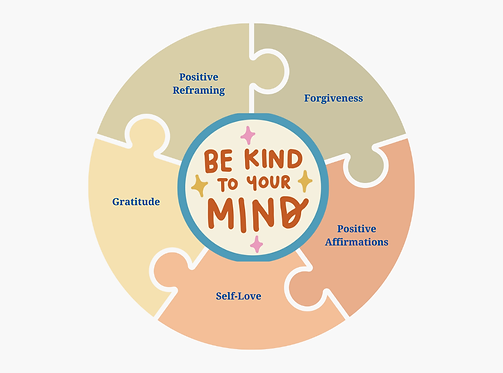
Right mind also means engaging in self-love and self-forgiveness, which can also be achieved through positive reframing and using positive affirmations.

Positive Reframing
One example of positive reframing would be, when a medical student doesn't do as well as they wanted on an exam, they may experience negative self-talk such as 'I am not good enough for medical school.' Reframing a negative thought like that would look like 'I am a student, I am learning, and I am doing my best.'
Negative self-talk, often referred to as cognitive distortions, are prevalent amongst medical students and can be a barrier to academic success. In order to reframe negative thoughts to positive ones, you must be able to identify them through self-awareness. One strategy for positive reframing is asking yourself, 'what evidence do I have?' Thus, challenging the maladaptive negative thought. (Herrick et al., 2025)
Gratitude
Practicing gratitude is a specific strategy for achieving right mind. Focusing on the things that you are grateful for in life is another way of turning negative thoughts around to positive thoughts. Practicing gratitude reminds us that there are good things in our lives besides stress. Diniz et al (2023) conducted a meta-analysis of studies on the effects of practicing gratitude and found that it reduced symptoms of anxiety and depression and increased an overall satisfaction of life. In fact, there is scientific reasoning for how practicing gratitude can enhance satisfaction.
In their article 'Does Gratitude Rewire Your Brain?', the American Brain Foundation (2025) states that practicing gratitude daily activates the parasympathetic nervous system (PSN) which combats 'fight or flight' triggered by the sympathetic nervous system (SNS). In other words, purposefully reframing self-talk that is rooted in unproductive feelings such as shame, guilt, and fear will counteract 'fight or flight' and lead you to feeling enhanced satisfaction. Being purposeful about practicing gratitude and positive reframing can be achieved through self-awareness and by focusing on forgiveness, self-love, and using positive affirmations.
You can easily incorporate gratitude activities into your daily routine. Practicing gratitude activities can be as simple as listening to a 5-minute guided meditation on gratitude, acknowledging each morning the aspects and people of your life that you are thankful for, or reading quotes on gratitude daily.
Self-Awareness
Saunders et al. (2007) found that a mindfulness-based stress reduction (MBSR) group with first year medical students helped them gain self-awareness of their strengths and limitations. By understanding themselves better, they were able to prioritize self-care and find balance. Additionally, their stress levels were reduced as well.
Ouliaris (2019) states that mindfulness meditation and self-reflection writing are two effective methods for achieving self-awareness.
-
Mindfulness Meditation: Breath work can assist with practicing mindfulness meditation so that you can quiet the mind. When the mind is quiet and the heart rate has slowed down, the mind is able to find clarity because it isn't being driven by emotion. This practice also helps the mind and body to step out of 'flight or fight' mode, which is a normal response to feeling overwhelmed with stress and anxiety.
-
Self-Reflection Writing: Once you have quieted the mind, you can also self-reflect. During this process, you can engage in self-reflective writing which will help you express thoughts and emotions. Mind mapping is a creative tool for self-reflection writing and finding self-awareness. Use the mind mapping worksheet below to learn more about some of your thoughts, fears, needs and emotions.
